The Carbon and Silicon Balance

Across boardrooms right now, a quiet trade is being made. Under pressure to find efficiency and protect margin, organisations are shifting work from people to AI as fast as the technology allows. The logic is sound and the gains are real. But the speed hides a cost that does not show up on this quarter's numbers. Every time a process moves wholesale from human hands to a machine, the accumulated knowledge held by those hands is at risk of being deleted, and unlike a software rollback, it does not come back.
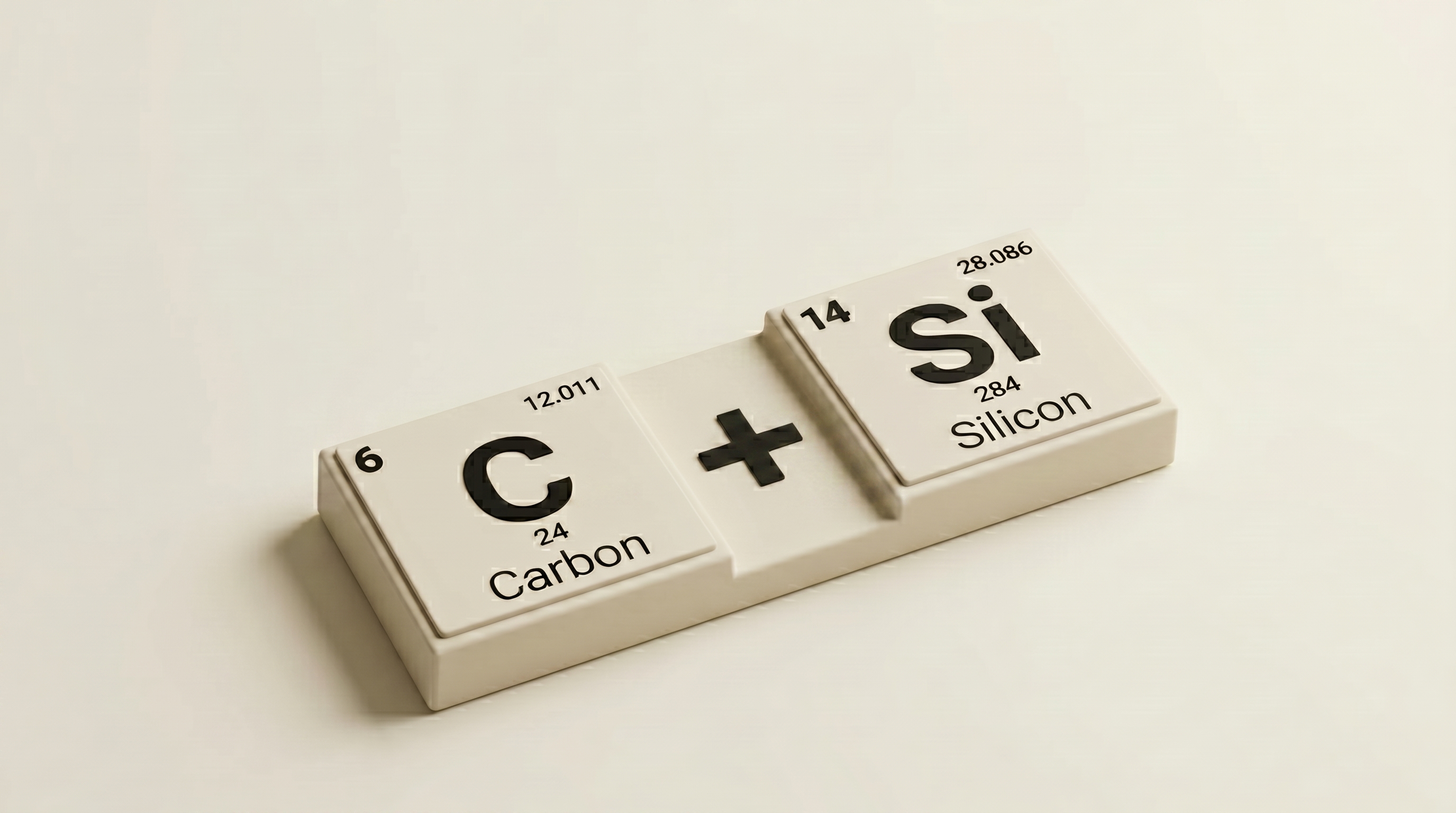
We want to offer a way to think about this deliberately rather than by accident. Borrow a frame from chemistry. Carbon is the basis of biological life; call it the human component of an organisation: judgement, context, relationships, the hard-won instinct of people who have seen things go wrong before. Silicon is the basis of computation; call it the AI component: speed, scale, tireless recall, pattern-finding across more data than any person could hold. Most real work is some compound of the two. The question is not whether to use AI, but in what ratio, for which functions, and how fast to change it.
We call this the Carbon and Silicon balance. It is not a call for a 50/50 split, which would be arbitrary. Balance here means the right ratio for a given task. For some functions the optimal mix is heavily Silicon; for others, the human element is precisely the value the customer is paying for, and automating it destroys what you were trying to scale.
What does getting the ratio wrong look like in practice? Consider three patterns.
A support team automates first-line responses and cuts cost immediately. But the senior staff who used to handle hard cases were also the ones quietly training the juniors. Two years on, there is no one who can handle the cases AI escalates, because the apprenticeship pipeline was switched off without anyone deciding to switch it off. The ratio swung too far, too fast, and the institutional memory went with it.
An underwriting function adopts AI scoring and standardises decisions overnight. Efficiency is up. But the edge cases, the ones where a human noticed something the model could not see, now sail straight through, and the deficit only becomes visible when those cases turn into losses.
A design studio uses AI to accelerate production. Here the ratio holds, because the firm kept humans firmly in the creative and client-judgement seats and pushed Silicon only into the repetitive execution layer. Same technology, deliberate ratio, opposite outcome.
The pattern across all three is the same lesson history keeps teaching whenever an industry re-tools at speed. Rapid, uncontrolled change tends to create a deficit of established value that nobody priced in. The offshoring waves and earlier automation cycles each delivered their promised savings and each left organisations relearning, at cost, things they used to simply know.
The discipline, then, is to treat the Carbon and Silicon ratio as something you set consciously, function by function, and adjust at a rate your organisation can actually absorb, keeping the human knowledge that took years to build while you layer the machine capability on top of it.
Power is best used with careful, controlled action. More than ever, this is a moment for evolution, not revolution.
Related reading: we apply this same balance to the problem of spotting a winning product in Lightning in a Bottle, where human intuition sets the question and AI-scale observation answers it. And in The Growing Desire for Genuine & Authentic we look at the trust layer this relationship will need to stand on.